

Is Expensive Audio Equipment Worth It
Last Updated: October 11, 2026
Does Expensive Audio Sound Better
Whether expensive audio equipment sounds better depends less on price and more on audible improvement, system matching, and your hearing ability.
Expensive gear includes superior engineering and materials, but “better” doesn’t always mean noticeably better to your ears. An amplifier may measure more precisely, yet the difference in your listening room might be subtle or inaudible.
The real question isn’t whether expensive audio equipment is worth it in absolute terms, but whether it’s worth it for your specific situation, room, music, and listening goals.
Budget vs High-End Speakers: What Changes
Budget and high-end speakers differ most in frequency response accuracy, dynamic range, and harmonic distortion. Budget speakers emphasize certain frequencies for initial impact; high-end speakers aim for neutrality across the full spectrum.
High-end speakers reveal more detail, subtle background instruments, vocal textures, spatial information, but only if your source material, amplifier, and room can deliver them.
Upgrading speakers alone often disappoints. A $60,000 speaker with a $5,000 receiver in an untreated room often sounds worse than a $30,000 speaker with a quality amplifier and basic room treatment. System matching matters more than any single component’s price.
Build quality improves with price: better cabinet materials, superior crossovers, and rigorous assembly contribute to longevity. A speaker costing three times more should last longer and maintain sound characteristics over decades.
System Matching and Component Synergy
Expensive audio equipment only delivers its potential when paired with compatible components. A world-class amplifier with mediocre speakers wastes capability; a revealing speaker with a noisy amplifier exposes noise rather than music.
Professional guidance helps match components so each amplifies the others’ strengths. A $10,000 amplifier with the right speakers, cables, and source creates a coherent system; paired randomly with budget components, it often underperforms a modest system built with intention.
System synergy explains why similar-priced systems sound dramatically different. A thoughtfully assembled system with matched components typically sounds significantly better than one built by choosing the most expensive option in each category.
Audio System Upgrade Priorities: Where Spending Matters Most
Not all spending delivers equal returns. Upgrade priorities depend on your system’s weakest link, listening goals, and total budget.
The upgrade hierarchy: where to spend first
Room acoustics and placement come before any equipment purchase. A $150,000 system in an acoustically treated room may outperform a $500,000 system in an untreated room. Basic treatment costs can be reasonable and can deliver more audible improvement than misguided upgrades to amplifiers or cables, the single highest-return investment for most listeners.
Speaker selection typically comes first. Speakers determine how much amplifier capability reaches your ears and how room interaction colors the sound. A speaker upgrade often has a greater audible impact than an amplifier upgrade.
Amplifier quality matters after optimizing speakers and room acoustics. Quality amplifiers handle most speaker loads competently; diminishing returns accelerate unless your speakers demand specific impedance characteristics or your room is very large.
Source quality. A high-end amplifier and speakers cannot improve poor-quality source material. Upgrading from compressed audio to lossless formats and quality streaming services often yields more noticeable improvement than expensive equipment, typically costing $10-$20 per month with no hardware change.
Cables and accessories come last. Quality cables prevent signal degradation, but their impact is subtle compared to speakers or amplifiers.
The upgrade sequence for existing systems
If you already own a system and want to improve it, follow this order:
- Measure and treat your room. Use a smartphone app or rent a measurement microphone to identify acoustic problems. Add absorptive panels and bass traps where needed. This step costs $500-$2,000 and often yields 30-50% improvement in perceived clarity and bass control.
- Optimize speaker placement and listening position. Move speakers away from walls, adjust toe-in angle, and position your listening seat for balanced bass response. This costs nothing and can noticeably improve soundstage and bass accuracy.
- Upgrade your source if it’s limiting. If you’re streaming compressed audio or using a low-quality DAC, upgrade to lossless streaming or add a dedicated DAC. This is often more impactful than amplifier upgrades.
- Upgrade speakers if they’re the weak link. If your current speakers sound thin, boomy, or lack detail, replacing them will deliver an obvious improvement. Budget for a meaningful upgrade.
- Upgrade the amplifier if speakers and room are already optimized. At this stage, amplifier quality becomes audible. An upgrade typically brings noticeable refinement in dynamics and low-level detail.
- Add cables and power conditioning last. Quality cables prevent degradation, but their impact is subtle. Power conditioning helps if you hear hum or noise, but it’s rarely the limiting factor.
When to break the hierarchy
Some situations warrant different priorities. If you listen primarily through headphones, skip room treatment and speakers; invest in a quality headphone amplifier and headphones. If you have a dedicated listening room already treated by a professional, prioritize speakers and amplification.
How to Audition Audio Equipment
Auditioning in a dealer’s demonstration room reveals capabilities spec sheets never capture, but requires specific practices to avoid bias. The most common mistake is relying on subjective impressions alone; louder always sounds better at first, and expectation bias distorts perception.
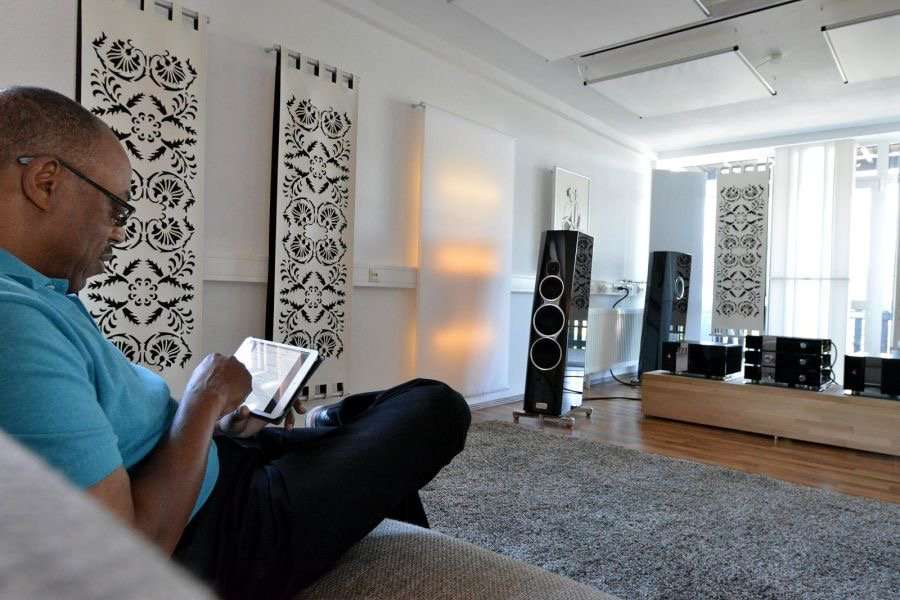
Step-by-step process for comparing expensive audio equipment.
Controlled listening techniques separate real differences from bias:
Level-matched comparisons are essential. Ensure both components play at identical volume levels, measured with a sound-pressure-level meter. A 3-decibel difference makes one sound obviously “better” even if components are identical.
Familiar music and extended listening matter. Bring recordings you know intimately; unfamiliar music makes it hard to detect equipment changes. Listen for at least 15-20 minutes with each setup; initial impressions often reverse after ear adaptation.
Single-variable changes isolate cause and effect. Ask the dealer to change only one component at a time, keeping everything else identical.
Take structured breaks. Ear fatigue distorts perception after 20 minutes of critical listening. Rest for 10 minutes in a quiet space before resuming. This prevents adaptation from masking real differences or creating false impressions.
We offer appointment-based auditions specifically designed to apply these methods. The environment, equipment selection, and expertise create conditions where you hear genuine differences rather than marketing impressions or expectation bias.
Diminishing Returns and Total Cost of Ownership
Expensive audio equipment follows a steep diminishing returns curve. Upgrading speakers brings 60-70% of the improvement; upgrading the wrong equipment can bring only 20-30% additional improvement.
Early upgrades deliver obvious improvements; later upgrades require increasingly sensitive ears and careful listening conditions.
Total cost of ownership extends beyond purchase price. High-end equipment often requires power conditioning, quality cables, and room treatment, adding substantially to true cost.
Resale value matters for expensive audio equipment. Quality components from established brands retain 40-50% of their value over five years. Budget equipment often loses 70-80% of its value. If you might upgrade later, expensive equipment’s resale value partially offsets its cost.
When Premium Gear Delivers Real Value
Expensive audio equipment justifies its cost in specific situations. If your room is acoustically optimized and your system has clear, audible limitations, upgrading to premium components often delivers noticeable improvement.
If you listen critically for several hours daily, subtle differences become meaningful. Premium gear’s refinement pays dividends across thousands of listening hours.
If you’re building a system you intend to keep for 10+ years, expensive components’ longevity and consistency justify higher upfront cost. Budget equipment often degrades noticeably within 3-5 years.
If your music collection includes high-resolution recordings or demanding genres like classical or jazz, revealing components extract more from the source material.
Situation | Best Approach | Why It Works |
|---|---|---|
New to high-end audio | Start with mid-range high-end components and room treatment | Establishes foundation before expensive upgrades |
Acoustically untreated room | Treat room before upgrading equipment | Room acoustics impact matters more than component price |
Upgrading existing system | Identify weakest link first | Focused spending delivers maximum improvement |
Critical listening daily | Invest in premium components | Subtle refinements become audible across many hours |
Budget-conscious listener | Prioritize speakers and room treatment | Delivers better results than expensive amplifiers alone |
Whether expensive audio equipment is worth it depends on your current system’s weak points, your listening environment, and how critically you listen. Rather than chasing the highest price tags, focus on systematic improvement: optimize your room, match components thoughtfully, and upgrade in priority order. At The Voice That Is, we guide discerning listeners through this process with professional auditions of world-class brands like TIDAL Audio, Air Tight, Bricasti Design, and Vinnie Rossi. Our appointment-based approach ensures you hear genuine differences before investing in expensive audio equipment. Call us at 610.359.0189 to schedule your personalized audition and discover whether premium components transform your listening experience.
Frequently Asked Questions
Does expensive audio equipment really sound noticeably better?
Yes, but with caveats. Premium audio components often deliver measurable improvements in clarity, detail, and soundstage when properly matched and auditioned in a controlled environment. However, the audible difference depends on your listening ability, room acoustics, and the specific music you play. Personal preference and system synergy matter as much as the cost of individual components.
What's the real difference between budget and high-end speakers?
Budget speakers often have acceptable frequency response but may lack precision in the midrange and upper registers, resulting in fatiguing listening over time. High-end speakers typically use superior materials, better engineering, and refined crossover design to reproduce music with greater accuracy and nuance. The perceived difference is most noticeable in acoustic music, vocals, and complex orchestral passages. However, room placement and acoustics can sometimes matter more than speaker price alone.
Which audio components should I prioritize spending on?
Prioritize in this order: room acoustics first, then speakers, then source components (turntable, server, DAC, preamp), and finally amplification. Speakers have the largest impact on your listening experience because they're the final link between electronics and your ears. A great speaker paired with the right amplifiers outperforms mediocre speakers.
How do I know if an audio upgrade is actually worth the cost?
Listen to music you know intimately and listen for specific improvements: tighter bass, clearer vocals, more detailed cymbals, or a wider soundstage. Track total cost of ownership, including potential resale value, rather than focusing on the price tag alone. Our goal is to help you avoid buying mistakes.